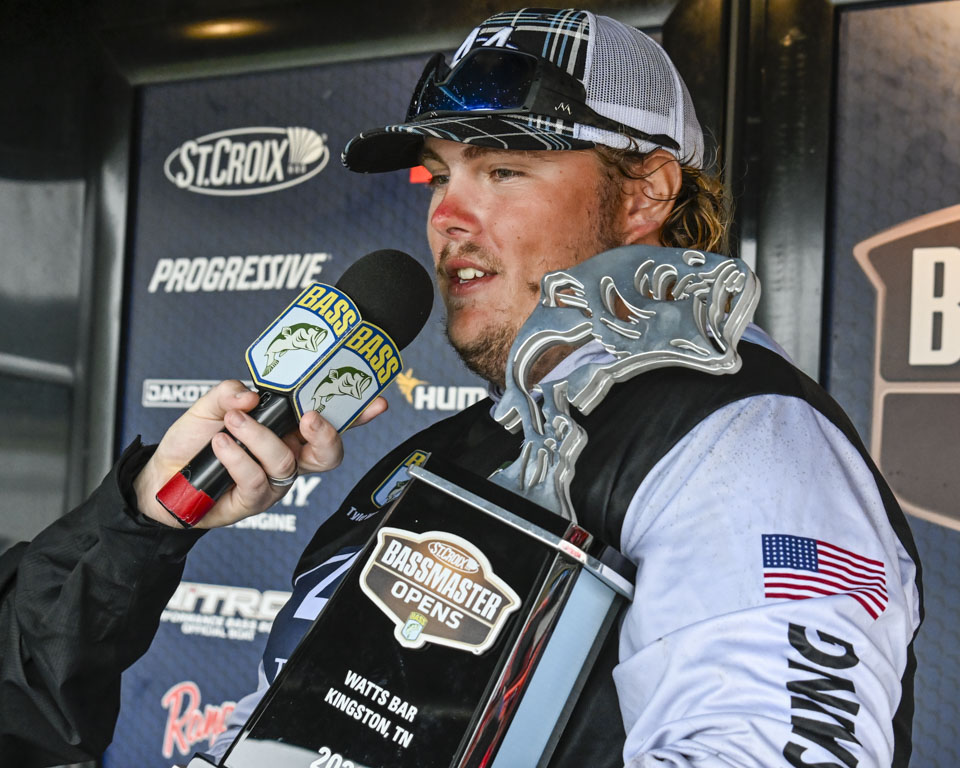
Event: 2023 St. Croix Bassmaster Open Div. 3 at Watts Bar Reservoir
Scenario: In the first year of the St. Croix Bassmaster Open Elite Qualifiers, Tyler Williams would secure his 2024 Bassmaster Elite Series invitation by overcoming two bombs, 102nd at Toledo Bend and 96th at the St. Lawrence River, with a quartet of Top 10s — fourth at Eufaula, Okla.; a win at Watts Bar; eighth at Lake of the Ozarks; and ninth at the Harris Chain.
Coming off that St. Lawrence disappointment, Williams knew he needed a strong performance to get his season back on track and salvage his Elite Series dream. Doing so would require a potent mix of versatility, tenacity and self belief.
“In the morning, I didn’t have a really good bite, so I’d start midlake on something that looked good,” Williams said. “I’d catch one or two good ones to start the day and then I would run down to Spring Creek by the (Watts Bar) dam. I knew I had to fish that from 10 a.m. to noon.
“The current would kick on at noon, so I’d run all the way up, kind of toward takeoff, where the current would first start really going. I’d fish the current-oriented stuff, and usually I could catch two good fish off each spot.”
Focusing on isolated spots like big stumps on channel swings, or bluffs with steps, Williams hit approximately 25 spots each day, with maybe five of them producing the quality he sought. Calling that event a tough summer scenario, Williams said the fish were in the right places, but clearly influenced by heavy fishing pressure.
“They had seen a lot of baits, so you had to do off-the-wall stuff,” he said. “It was a mix of presentations and the way I could get them to bite. Also you had to think about where other people wouldn’t fish in that little section. That’s usually what I would capitalize on.”
The decision: Essential to Williams’ success was his belief in his signature technique and his ability to adapt. No surprise, Williams did most of his work with a 3/4-ounce Greenfish Tackle living rubber jig fitted with a Yamaha Flapping Hog trailer.
This big-fish bait produced well during the first two days’ mostly calm, clear conditions and dependable current. When the final round brought overcast skies, wind, rain and less water movement, he didn’t throw in the towel — he simply adjusted his presentation.
“A lot of fish would kind of suspend, so I had to fish the jig up and let them chase it to the bottom,” Williams said.
While this adaptation clearly helped his cause, Williams said his most important decision was purely a mental strength deal.
Early into the first day, Williams lost the use of his trolling motor and shallow-water anchors. Unfamiliar with the lake, such a loss in positioning strategy could have easily caused a major spin out, but Williams persevered and made one of the most impressive adjustments in tournament history.
“I lost my trolling motor at 9 o’clock, but I stayed in it mentally,” he said. “I’d pull up to spots, put my trolling motor down and then I’d have to bend over the bow and turn the head of my trolling motor to adjust my LiveScope transducer to be able to see what I was fishing.
“The boat would drift like crazy, but I kept my head in it and caught seven fish that day. I caught a 4-15 right at the boat ramp about 30 minutes before check-in, and then I caught a 3-pounder.”
Despite this severe limitation, Williams made the most of his casting angles and sacked up his best bag of the event — 14-15 — to place second on Day 1. He’d add a second-round limit of 14-6 to take the lead and seal his win with a Championship Saturday limit of 11-15 and a final 3-day tally of 41-4.
Game changer: Williams said the physically demanding effort requisite to salvaging a day without trolling motor power paled in comparison to the sense of accomplishment he experienced. The Elite EQ system was conceived with the purpose of ensuring each new rookie was ready for the highest level of competition.
Suffice to say, Williams checked that box.
“That decision to stay in it and not give up was bigger than the tournament,” Williams said. “That was one of the proudest moments of my career. I think that’s what triggered me to (finish the season well) and make the Elites — making that decision to stay in it.”
Williams opening-round challenge was amplified by his minimal Watts Bar experience.
“I had pre-practiced (the lake), but I hadn’t fished any big tournaments,” he said. “I had a lot of stuff marked from pre-practice, so I had to categorize them into one-cast spots — stumps, isolated rocks, brushpiles — where I had to roll up and make one cast. That turned into my game plan.”
Williams had to fish either kneeling at his bow or crouched low. Definitely an ends-justifying-the-means scenario, but not one without a cost.
“When I lost my trolling motor, I immediately knew I could (manually adjust my trolling motor head) but it took a lot out of me, having to bend over so far,” he said. “Every hook set was awkward because I was bent over so far, or I was on my knees.
“It was so stressful that for the next two days, I could hardly walk. I was so sore.”
Takeaway: Looking back, Williams said his first Bassmaster trophy represents not only his proven angling ability, but that critical ability to adapt and overcome.
“I really think your mentality is the most important part of fishing,” Williams said. “That event and then the way I made the Elites, where I kind of just locked into doing what I do, like throwing a jig, was very important.
“Doing what you want and not worrying about what other people say and not letting your mentality get changed, that’s been the most important lesson for me.”