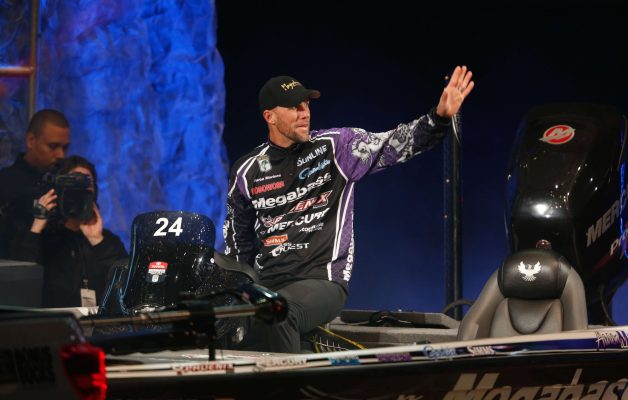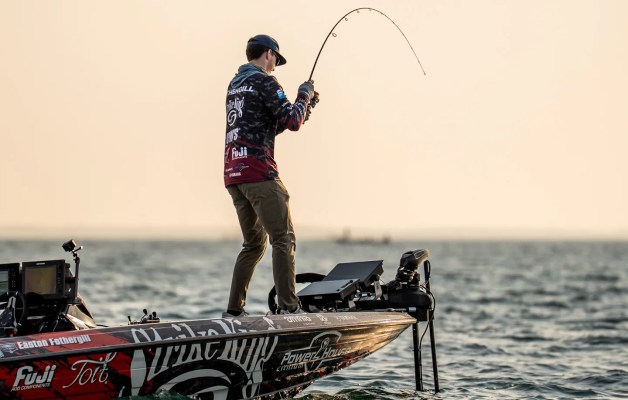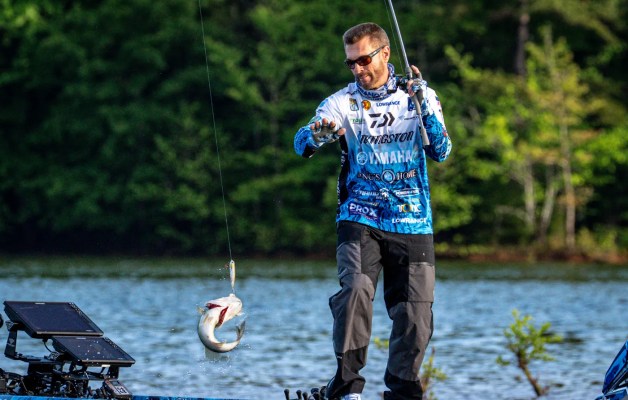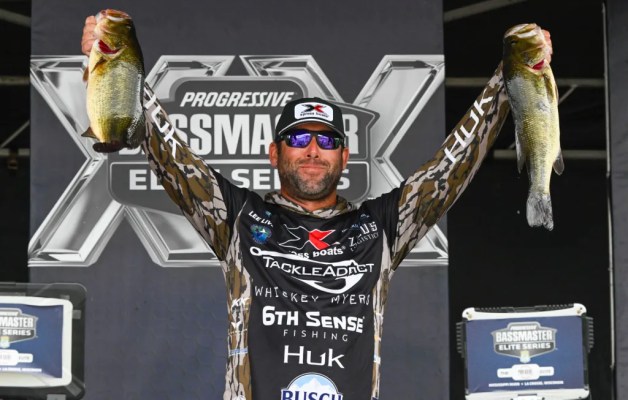
Event: 2013 Bassmaster Elite at St. Lawrence River
Scenario: Having notched his first Elite victory a year prior at Bull Shoals Lake, Palaniuk was, no doubt, hungry for another blue trophy. However, this event run out of Waddington, N.Y., carried an even greater sense of urgency.
Making the victory ever sweeter was the pure redemption it brought. Two months prior, Palaniuk had suffered a serious setback during the Elite event at the Mississippi River after it was determined he had culled in Minnesota waters — a violation of state law.
After leading the event for the first two days, Palaniuk had his second-round weight erased. That dropped him out of the Day 3 cut and jeopardized his 2014 Classic qualification. Once the news had settled, Palaniuk famously predicted a St. Lawrence victory.
“I was with (Bassmaster Emcee Dave) Mercer and when we were leaving the parking lot, I just said jokingly, ‘Well, I guess I’ll just go win the next one,” Palaniuk said. “I had the attitude that I was capable of doing it, but I didn’t know anything about the St. Lawrence at that time. I didn’t know how big it was.
“Really, I was kind of oblivious, so that was kind of my way of shrugging off what happened at the Mississippi River and letting it go. I said it half-heartedly and then it actually worked out.”
Recalling the motivation he took into that final 2013 event, Palaniuk said: “I knew that I needed to win because the DQ dropped me so far down in AOY points. That’s when we still had win-and-you’re-in (format).”
Intent on claiming the elusive prize, Palaniuk invested intense study of St. Lawrence mapping, as well as catch histories. At the time, the St. Lawrence potential had yet to reach mainstream awareness, so Palaniuk went into the event with an open mind.
“There hadn’t been a major tournament up there since the introduction of gobies and zebra mussels, but when I looked at the weights, they were always bigger in tournaments that were closer to the lake,” he said. “Looking at the contours on such a large body of water, I thought there was no way I could break down this river with this many contours and islands to know where these fish are living.”
Knowing his best shot at winning would require a long run, Palaniuk rose at 4 a.m. the first day of practice and drove southwest to Henderson Bay, on Lake Ontario’s upper east side. Arriving with no distinct plan, he simply dropped his trolling motor and went down the bank.
Searching for grass, rock and anything that looked good, Palaniuk started out throwing a topwater and quickly caught a 4-pounder. Between a topwater, a jerkbait and a drop shot, he’d end up catching 25 to 26 pounds on that shallow bite.
“I slept in my truck that night and went out there again the next day and started deep,” Palaniuk said. “The very first place I stopped on, I caught three 5-pounders on three consecutive casts.
“I quickly realized I could catch 25-plus out deep, but I could do it much quicker than I could up shallow. With that long of a run (during the tournament), it was evident to me that I could use the shallow stuff as a backup plan and primarily fish deeper structure with side imaging, down imaging and 2D sonar.”
After two days of practice, Palaniuk felt confident that he’d marked more spots than he could fish in a four-day event, so he spent his third practice day learning to run the river. Identifying navigational concerns and determining where to get fuel, Palaniuk readied himself for the type of bold mission that big dreams often require.
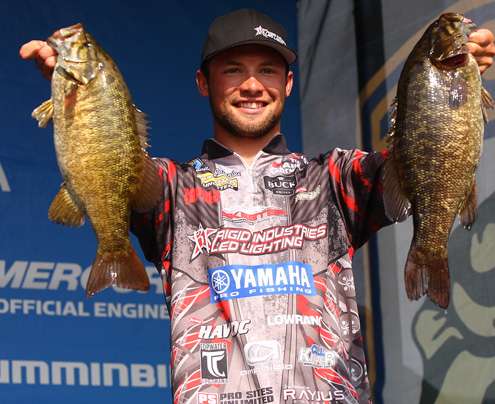
The Decision: Posting daily weights of 23-9, 21-5, 20-9 and 23-5, Palaniuk notched a wire-to-wire victory with a four-day total of 88-12 and a winning margin of 7-8. His tactics were simple — caught ‘em all on a drop shot. However, committing to what many considered an impossible plan would end up delivering the goods and establishing a new reality that many would replicate in coming years.
“The biggest thing was just deciding to go to the lake,” Palaniuk said. “That put me in a different caliber of fish at that time. I never saw another bass boat for four days. All of the field fished the river. Word started getting out that I was going to the lake and then everyone was like, ‘There’s no way he’s doing that four days,’ and every day I’d show up at weigh-in.
“Just making it back felt like a feat in itself. It was pretty rough every day. The fastest I made it was just over two hours. One day, it took me three hours. Over four days, I fished 10 hours out of a possible 32. I spent 22 hours driving, for the most part.”
Game Changer: Palaniuk’s unshakable belief in a, then, far-fetched idea clearly accomplished the objective in dramatic form. Along the way, knowing he had the tools for the job made all the difference.
“I think separating myself from everyone else and trusting my equipment was the key,” Palaniuk said. “I ran something like 800 miles in four days.
“Back then, everyone thought I was insane. There’s no way you’re gonna make it down there and back four days. Now, it seems most of the field does it, but back then, no one was running from Waddington all the way out to the lake.”
Takeaway: Now, many years removed from the experience, Palaniuk attributes his achievement to his willingness to literally go the extra mile(s) to claim not only the short-term goal of winning, but also to secure his 2014 Classic spot.
“I think for me, it was being able to dig deep and almost grab another gear when your back’s against the wall,” Palaniuk said. “Rather than just giving up, do the opposite. My main goal was to make the Classic. At the beginning of that year, I had finished second to Cliff Pace in the Classic, so I was hungry to get back.
“It was ‘do whatever you need to do to get back there,’ and if that meant gambling and making the run to the lake, that’s what I needed to do. Rather than looking at something and saying it’s impossible, it was about figuring out how to make it possible.”